Blog
How to Measure Your Ring Size at Home (US Size Chart)

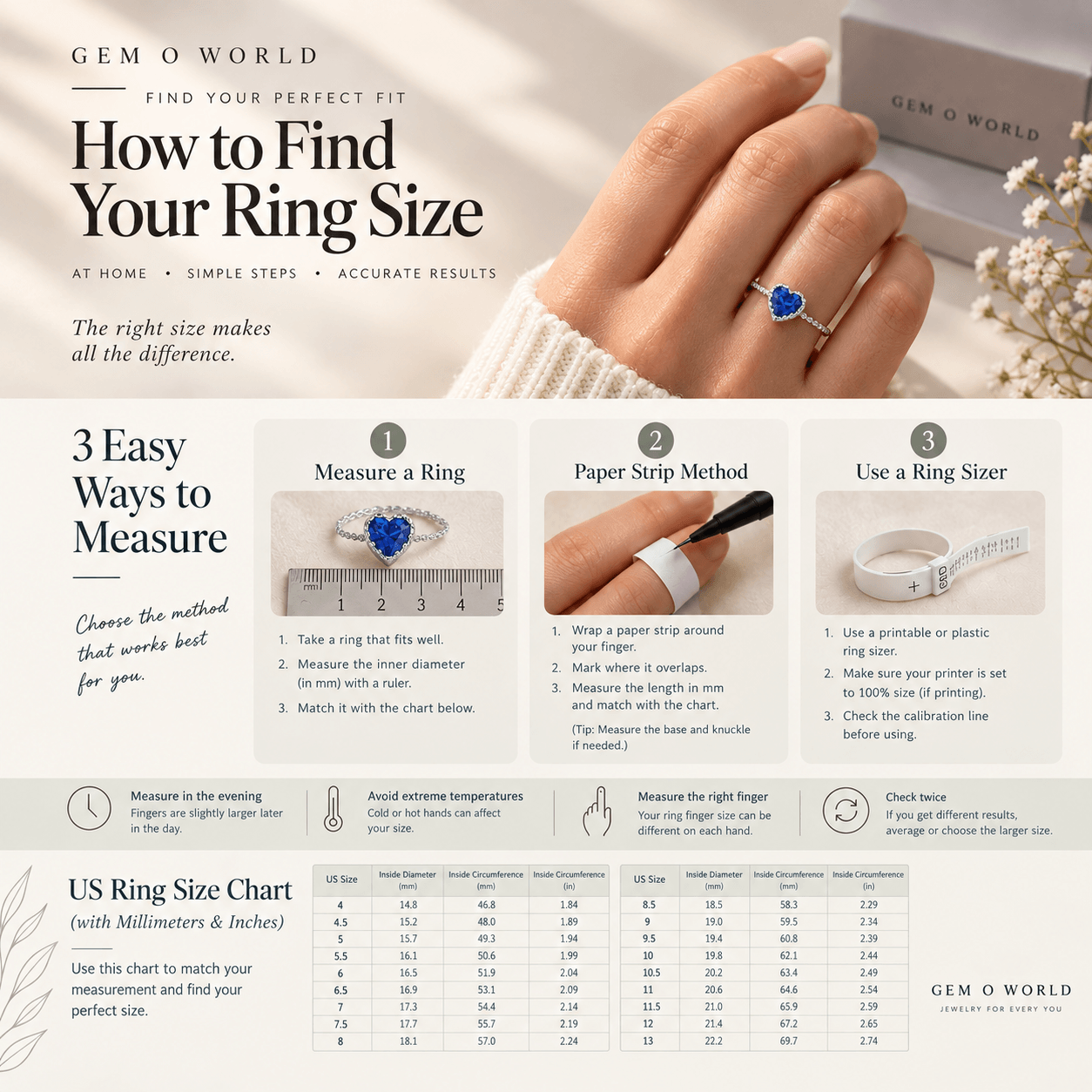
Buying a ring online is easy right up until the size dropdown appears. If you’ve ever guessed “probably a 7” and ended up with a ring that spins all day or won’t get past your knuckle, you’re in good company. The good news: you can find your US ring size at home in about ten minutes with things you already own. This guide walks you through three reliable methods, gives you a full size chart with millimeter measurements, and covers the fit details most charts skip.
The Quick Answer
The most accurate at-home method is to measure the inside diameter of a ring that already fits the finger you’re shopping for, then match it to the chart below. No ring to borrow? Wrap a strip of paper around the base of your finger, mark where it overlaps, measure that length in millimeters, and match it to the circumference column. Measure at the end of the day when your fingers are warm, and if you land between two sizes, go with the larger one.
Before You Measure: A Few Ground Rules
Fingers change size more than people expect. A few habits make your number much more trustworthy:
- Measure late in the day. Fingers tend to be smallest in the morning and slightly fuller by evening.
- Skip cold or hot moments. Cold hands shrink; heat, exercise, and salty meals can make them swell. Room temperature is ideal.
- Measure the exact finger. Your right ring finger and left ring finger are often different sizes, and your index finger is usually larger than your ring finger.
- Measure two or three times. If you get different readings, average them or go with the one that comes up most.
Method 1: Measure a Ring That Already Fits
This is the best option, especially if you’re buying a surprise gift and can quietly “borrow” a ring from their jewelry box for a few minutes.
- Pick a ring that fits the intended finger comfortably. A plain, round band works best; avoid rings that are bent or oval.
- Lay it flat on a ruler with millimeter markings.
- Measure straight across the inside edge, from one inner wall to the other, through the center. Don’t include the metal itself.
- Match that number to the “Inside Diameter” column in the chart below.
If you’re torn between two marks on the ruler, round up. A quarter of a millimeter makes a real difference here, so take your time and use good light.
Method 2: The Paper Strip (or String) Method
Paper is better than string because it doesn’t stretch, but either works if you’re careful.
- Cut a thin strip of paper, about 1/4 inch wide and 4 inches long.
- Wrap it snugly around the base of your finger. It should feel like a ring would: secure, but not pinching.
- Mark the spot where the paper overlaps with a fine pen.
- Unroll it and measure from the end to your mark in millimeters.
- Match that length to the “Inside Circumference” column.
One catch: the paper method measures the base of your finger, but a ring also has to slide over your knuckle. If your knuckles are noticeably larger than the base of your finger, wrap the paper around the knuckle too, and choose a size between the two readings.
Method 3: A Printable or Plastic Ring Sizer
Printable ring sizers and inexpensive reusable plastic sizers (the kind that loop through like a zip tie) are handy if you’ll be buying rings regularly. If you use a printable version, check that your printer is set to 100% or “actual size” and confirm the calibration line with a ruler before trusting the results. A printer that scales the page even slightly will throw off every size.
US Ring Size Chart (with Millimeters and Inches)
Use this chart with the measurement you took above. US sizes go up in half sizes, and each half size adds roughly 0.4 mm to the inside diameter.
| US Size | Inside Diameter (mm) | Inside Circumference (mm) | Inside Circumference (in) |
|---|---|---|---|
| 4 | 14.8 | 46.8 | 1.84 |
| 4.5 | 15.2 | 48.0 | 1.89 |
| 5 | 15.7 | 49.3 | 1.94 |
| 5.5 | 16.1 | 50.6 | 1.99 |
| 6 | 16.5 | 51.9 | 2.04 |
| 6.5 | 16.9 | 53.1 | 2.09 |
| 7 | 17.3 | 54.4 | 2.14 |
| 7.5 | 17.7 | 55.7 | 2.19 |
| 8 | 18.1 | 57.0 | 2.24 |
| 8.5 | 18.5 | 58.3 | 2.29 |
| 9 | 19.0 | 59.5 | 2.34 |
| 9.5 | 19.4 | 60.8 | 2.39 |
| 10 | 19.8 | 62.1 | 2.44 |
| 10.5 | 20.2 | 63.4 | 2.49 |
| 11 | 20.6 | 64.6 | 2.54 |
| 11.5 | 21.0 | 65.9 | 2.59 |
| 12 | 21.4 | 67.2 | 2.65 |
| 13 | 22.2 | 69.7 | 2.74 |
Measurements are standard approximations. Different manufacturers can vary by a fraction of a size, so if a specific product lists its own sizing notes, follow those.
Fit Tips Most Size Charts Don’t Mention
Wide bands fit tighter
A delicate 2 mm stacking ring and a chunky 8 mm statement band in the same size won’t feel the same. Wider bands cover more of your finger, so they feel snugger. For bands wider than about 6 mm, many people go up half a size.
Know what “a good fit” feels like
A well-fitting ring slides over your knuckle with a little resistance and a gentle twist, then sits comfortably at the base without spinning freely. It shouldn’t leave a deep red mark or feel tight when your hands are warm.
Large knuckles need a compromise
If a ring that fits over your knuckle spins at the base, size for the knuckle and consider a ring with a slightly heavier top (like a gemstone setting), which helps keep it upright. Sizing beads or a ring guard can also take up a little extra space.
Seasons and pregnancy change things
It’s normal for your size to shift a half size between summer and winter. If you’re pregnant, recently had a baby, or your weight has changed, consider waiting or choosing an adjustable or open style for now.
Sizing a ring for someone else
Sneaking a measurement for a gift? Borrow a ring they wear on the same finger you’re shopping for and use Method 1. If you can’t, ask a close friend or family member, or compare against your own fingers: if their ring slides onto your ring finger and stops at the middle knuckle, note where. When you really aren’t sure, an open or adjustable ring, a necklace, or earrings take the guesswork out completely. Our 2026 holiday jewelry gift guide has ideas if you’re shopping ahead for the season.
Common Ring Sizing Mistakes to Avoid
- Measuring with a stretchy material. Yarn and elastic string give you a smaller reading than reality.
- Measuring the outside of a ring. Always measure the inside edge only.
- Using one size for every finger. Index and thumb rings almost always need a bigger size than ring-finger rings.
- Assuming UK or EU sizes match. Other countries use letters or different numbers, so double-check which system a listing uses before ordering.
- Ignoring band width. As mentioned above, wide styles typically need a little extra room.
Keep Your Ring Fitting and Looking Its Best
Sterling silver is a lovely metal for everyday rings, but it’s softer than steel, so a thin band can slowly bend out of round if it’s knocked around or squeezed. Taking rings off before lifting weights or heavy chores helps them keep their shape (and their size). For cleaning and storage tips, see our guide on how to care for your 925 silver jewelry.
Frequently Asked Questions
What is the most common ring size for women in the US?
Many jewelers find that women’s ring sizes cluster around 6 to 7, but that’s only a starting point. Hands vary a lot, so measuring is always better than guessing.
Should I size up or down if I’m between sizes?
Size up in most cases. A slightly loose ring is more comfortable than a tight one, and it’s easier to make a ring smaller with a sizing insert than to stretch it. For thin stacking rings, the smaller size may work if it still passes your knuckle comfortably.
Can a sterling silver ring be resized?
Plain sterling silver bands can often be resized by a local jeweler, usually by about one size up or down. Rings with stones all the way around, intricate patterns, or plating are trickier, so ask a jeweler before assuming it’s possible.
Is my ring size the same on both hands?
Not always. Your dominant hand is often a little larger, sometimes by a half size or more. Measure the exact finger you plan to wear the ring on.
How accurate is the string method?
It can be close, but string stretches and is easy to pull too tight. A paper strip is more reliable, and measuring a ring that already fits is the most accurate at-home option.
Ready to Find Your Next Ring?
Once you know your number, shopping gets a lot more fun. Browse our women’s rings collection for everyday sterling silver bands and gemstone styles, explore bold cocktail rings if you want something with presence, or check out the men’s silver rings if you’re sizing for someone else. A classic like the Floral Design Solitaire Sterling Silver Ring is an easy place to start. Take your time, measure twice, and pick the one you’ll want to wear every day.