Blog
Bracelet Size Guide: How to Measure Your Wrist at Home

You found the perfect bracelet, you’re ready to check out, and then the dropdown asks for a length. 6.5 inches? 7? 7.5? Bracelet sizing trips up a lot of shoppers because, unlike ring sizes, there’s no single number system. The good news: once you know your wrist measurement and how you like a bracelet to sit, picking the right size takes about two minutes.
Quick Answer: What Bracelet Size Do I Need?
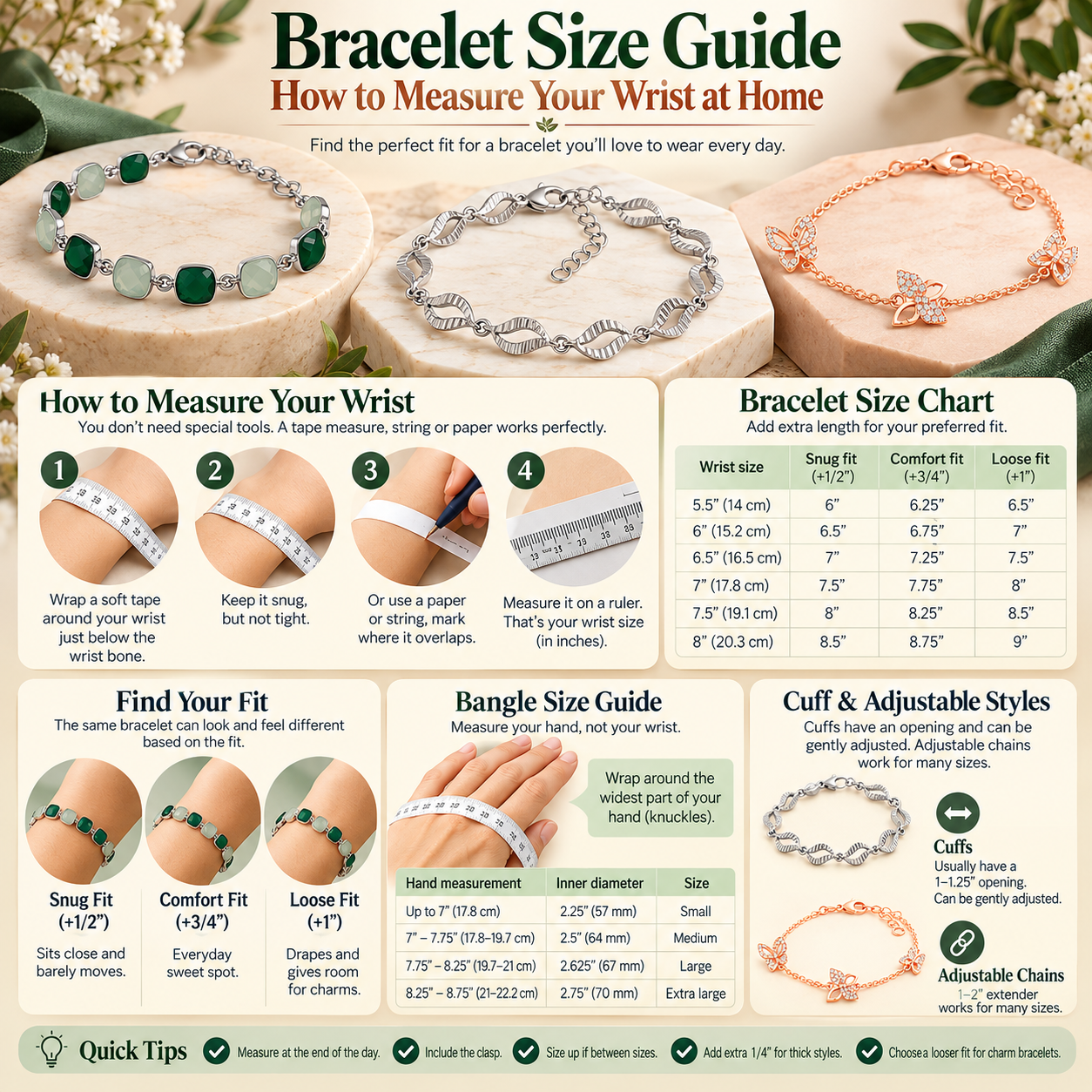
Measure your wrist just below the wrist bone, then add about 1/2 inch for a snug fit, 3/4 inch for a comfortable fit, or 1 inch for a loose fit. The most common women’s bracelet length in the US is 7 inches, which suits a wrist of roughly 6 to 6.5 inches.
That rule works for chain, tennis, and link bracelets. Bangles and cuffs are a bit different, and we’ll get to those below. If you’re browsing our women’s bracelet collection, keep your wrist number handy so you can compare it against each listing’s length.
How to Measure Your Wrist at Home
You don’t need special tools. Grab one of these:
- A soft tape measure (the sewing kind) is the easiest and most accurate.
- A strip of paper or a piece of string plus a ruler works fine too.
- Wrap the tape or string around your wrist right where you’d wear a bracelet, usually just above the wrist bone on the hand side.
- Keep it snug against the skin, but not tight. You shouldn’t see the skin dimple.
- If using paper or string, mark where the end overlaps, then lay it flat against a ruler.
- Write down the number in inches (to the nearest 1/4 inch). That’s your wrist size, not your bracelet size.
- Measure your dominant wrist separately if you plan to wear the bracelet there. It’s often slightly larger.
One tip from experience: measure at the end of the day. Wrists can swell a little with heat, salt, or activity, and a bracelet that fits at 8 a.m. can feel tight by dinnertime.
Already own a bracelet that fits?
Lay it flat, open the clasp, and measure from one end to the other, including the clasp. That total length is the number to look for when you shop. Don’t measure it closed in a circle, since that skews the result.
Bracelet Size Chart (Chain, Link & Tennis Bracelets)
Find your wrist measurement in the left column, then choose the fit you like.
| Wrist size | Snug fit (+1/2″) | Comfort fit (+3/4″) | Loose fit (+1″) |
|---|---|---|---|
| 5.5″ (14 cm) | 6″ | 6.25″ | 6.5″ |
| 6″ (15.2 cm) | 6.5″ | 6.75″ | 7″ |
| 6.5″ (16.5 cm) | 7″ | 7.25″ | 7.5″ |
| 7″ (17.8 cm) | 7.5″ | 7.75″ | 8″ |
| 7.5″ (19.1 cm) | 8″ | 8.25″ | 8.5″ |
| 8″ (20.3 cm) | 8.5″ | 8.75″ | 9″ |
If you land between sizes, size up. A bracelet that’s a touch roomy is still wearable; one that’s too short simply won’t close.
Which fit should you choose?
- Snug: Sits close and barely moves. Good for delicate chains you want to stay put, or bracelets you wear while typing all day.
- Comfort: The everyday sweet spot. It moves a little but won’t slide over your hand.
- Loose: Drapes and shifts toward the hand. Great for charm bracelets, since charms need room to hang.
Bangle Size Guide: Measure Your Hand, Not Your Wrist
A solid bangle has no clasp, so it has to slide over the widest part of your hand. That means the measurement that matters is your hand, not your wrist.
- Bring your thumb in toward your pinky, as if you’re about to slip on a bangle.
- Wrap a soft tape around the widest part of your hand, usually across the knuckles and the base of the thumb.
- Note the measurement. Divide it by 3.14 to get the approximate inner diameter you need, or use the chart below.
| Hand measurement | Approx. bangle inner diameter | Common size label |
|---|---|---|
| Up to 7″ (17.8 cm) | 2.25″ (about 57 mm) | Small |
| 7″–7.75″ (17.8–19.7 cm) | 2.5″ (about 64 mm) | Medium |
| 7.75″–8.25″ (19.7–21 cm) | 2.625″ (about 67 mm) | Large |
| 8.25″–8.75″ (21–22.2 cm) | 2.75″ (about 70 mm) | Extra large |
Labels vary from brand to brand, so always check the inner diameter in the product details instead of relying on “small” or “medium” alone. Hinged bangles open up, so for those you can size closer to your wrist.
Cuff Bracelets and Adjustable Styles
Cuffs have an opening, usually about 1 to 1.25 inches wide, and you slide them on sideways at the narrowest part of your wrist. Choose a cuff whose inner length (not counting the gap) is close to your wrist measurement.
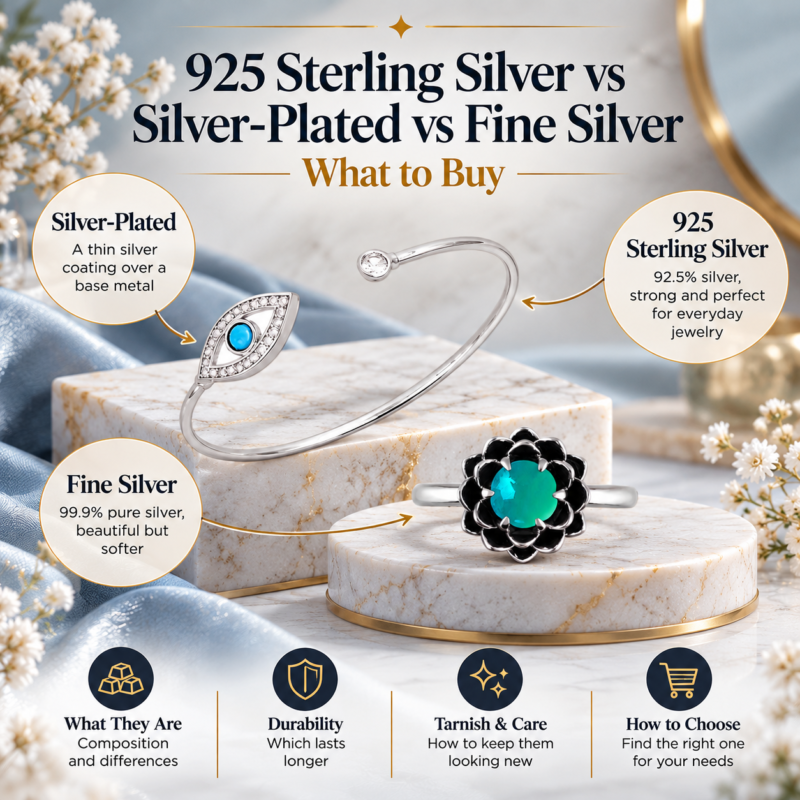
Many sterling silver cuffs can be gently adjusted. 925 sterling silver is 92.5% pure silver mixed with 7.5% other metals, usually copper, which gives it enough strength to hold its shape while still having a little flex. A few cautions:
- Squeeze or open a cuff slowly with even pressure from both ends, not by twisting one tip.
- Avoid bending it back and forth repeatedly. Metal fatigue can weaken the same spot over time.
- Skip adjusting cuffs with set stones near the ends, since pressure can loosen the setting.
Slider bracelets and chains with extenders are the most forgiving. A 1 to 2 inch extender chain lets one bracelet cover a range of wrist sizes, which makes them a smart pick for gifts.
Common Bracelet Sizing Mistakes to Avoid
- Ordering your wrist size as your bracelet size. A 6.5″ bracelet on a 6.5″ wrist will feel like a blood pressure cuff. Always add room.
- Forgetting about thickness. Chunky links, wide cuffs, and tennis bracelets with taller settings take up interior space. Add an extra 1/4 inch for thick styles.
- Ignoring the clasp. Some listings measure the chain only. If the description doesn’t say, ask or assume the stated length includes the clasp.
- Guessing for a gift. If you can’t measure their wrist, borrow a bracelet they already wear and measure it flat, or choose an adjustable style.
- Stacking without adjusting. When you wear several bracelets together, the stack sits better if the pieces are similar lengths, or if each one gets slightly longer as you move up the arm.
Fit Tips for Everyday Wear
A tennis bracelet usually looks best with a snug-to-comfort fit, so the stones stay on top of the wrist instead of spinning underneath. Delicate chains can go either way. Charm and bead bracelets almost always want the loose fit.
For gemstone bracelets, a little extra room also protects the stones. A bracelet that’s too tight puts constant pressure on the settings every time you bend your wrist. If you’re shopping for a gift and want something that’s easy to size, a simple style like this sterling silver amethyst bracelet is a lovely place to start, especially for a February birthday.
Frequently Asked Questions
What is the average bracelet size for women in the US?
The most common women’s bracelet length is 7 inches, with 6.5 and 7.5 inches close behind. A 7-inch bracelet generally fits a wrist that measures around 6 to 6.5 inches. If your wrist is smaller or larger than that, use the size chart to adjust.
How do I know my bracelet size without a measuring tape?
Wrap a strip of paper, a phone charging cable, or a piece of string around your wrist and mark where it meets. Lay it flat next to a ruler to read the measurement. Then add 1/2 to 1 inch depending on how loose you like your bracelets.
Should a bracelet be tight or loose?
Most people are happiest with a comfort fit, where you can slide one finger between the bracelet and your wrist. It should move a little but not slip over your hand. Charm bracelets are the exception and usually look better worn loose.
Can a sterling silver bracelet be resized?
Often, yes. A jeweler can usually remove links from a link bracelet, shorten a chain, or add an extender. Solid bangles are much harder to resize, so it’s worth measuring your hand carefully before you buy one.