Blog
Turquoise Guide: How to Choose and Care for December’s Birthstone

Turquoise is one of those stones you recognize from across the room. That sky-to-robin’s-egg blue, sometimes laced with dark veins, has been treasured for thousands of years, and it’s also one of December’s birthstones, which makes it a natural pick for holiday gifts and winter birthdays. If you’re browsing our December birthstone collection or just fell for a turquoise piece online, this guide walks you through what turquoise actually is, how to tell the different types apart, and how to keep it looking good for years.
What Is Turquoise?
Turquoise is an opaque mineral made of copper, aluminum, and phosphate, with water locked into its structure. The copper is what gives it that signature blue. When there’s more iron in the mix, the color shifts toward green.
A few quick facts worth knowing before you shop:
- Hardness: about 5 to 6 on the Mohs scale, so it’s softer than quartz, topaz, or sapphire.
- Porosity: natural turquoise can be porous, which means it can absorb oils, lotions, and dyes.
- Look: opaque with a waxy to slightly glossy shine. You won’t see sparkle or facets like you would with a clear gem.
- Where it’s found: well-known sources include Iran, the American Southwest (Arizona, Nevada, and New Mexico), China, and Egypt’s Sinai Peninsula.
That softness and porosity shape almost everything about buying and caring for turquoise, so keep them in mind as you read on.
Color, Matrix, and What Turquoise Has Meant Over Time
The color range
Turquoise runs from pale powder blue to deep sky blue to green-blue and even apple green. Many shoppers love the even, saturated “robin’s egg” blue, but greener stones have their own fans, especially in vintage and Southwestern-style jewelry. There’s no single “right” shade. Pick the one you’ll actually want to wear.
What “matrix” means
The dark brown, black, or golden lines you sometimes see running through turquoise are called matrix. They’re bits of the host rock the turquoise formed in. Some people prefer clean, matrix-free stones; others look for a strong spiderweb pattern because it makes each piece one of a kind.
Symbolism and tradition
Turquoise shows up across cultures and centuries. It was used in ancient Egyptian jewelry, prized in Persia, and has long been central to Navajo, Zuni, and Hopi jewelry traditions in the Southwest. It’s traditionally associated with protection, friendship, and good fortune, which is part of why it’s such a popular gift stone. Think of these meanings as folklore and sentiment, a nice story to share with the person you’re gifting it to, not a promise of any physical effect.
December’s Birthstones at a Glance
December is one of the few months with several official birthstones, so it helps to see how turquoise compares with the others.
| Stone | Typical color | Look | Mohs hardness | Everyday-wear notes |
|---|---|---|---|---|
| Turquoise | Sky blue to green-blue | Opaque, waxy shine | 5–6 | Best for earrings and pendants; protect rings from knocks |
| Blue topaz | Light to deep blue | Transparent, sparkly | 8 | Durable; great for rings worn daily |
| Tanzanite | Violet-blue | Transparent | 6–6.5 | Lovely but needs gentle handling |
| Blue zircon | Bright blue | Transparent, very fiery | 6–7.5 | Edges can chip; protective settings help |
Want an ocean-blue look you can wear every single day without worrying? Blue topaz is the tougher choice. Want something with an earthy, artisan feel? That’s where turquoise shines.
Natural, Stabilized, Reconstituted, or Imitation?
This is the most important part of buying turquoise, and it’s where a lot of shoppers get confused. Here’s how the main types break down:
- Natural (untreated) turquoise: cut and polished with nothing added. It’s the rarest and usually the priciest, and it’s more prone to absorbing oils and changing color over time.
- Stabilized turquoise: natural turquoise that’s been infused with a clear resin to harden it and lock in the color. This is very common, and it’s a perfectly good option for jewelry you plan to wear often.
- Reconstituted turquoise: turquoise chips or powder bonded together with resin and pressed into blocks. It’s real turquoise material, but it’s not a single natural stone.
- Imitation or simulated turquoise: other materials made to look like turquoise, such as dyed howlite, dyed magnesite, glass, ceramic, or plastic. These can be pretty and budget-friendly, but they aren’t turquoise.
Rule of thumb: if a listing just says “turquoise stone” without more detail, don’t assume it’s natural and untreated. Read the product description, and if it doesn’t say, ask the seller before you buy.
A few things that can tip you off
- Perfectly uniform color and pattern across many identical pieces can point to dyed or reconstituted material.
- Bright white showing in chips or scratches may suggest dyed howlite underneath.
- A very low price for a large, flawless “natural” stone is worth questioning.
None of these tests is foolproof at home. A gemologist or a detailed product description is the only reliable way to know exactly what you have.
How to Choose Turquoise Jewelry
Pick the right piece for the stone
Because turquoise is on the softer side, earrings and pendants are the easiest way to wear it. They don’t take the daily bumps that rings and bracelets do. If you love a turquoise ring, go for one with a bezel setting, where a rim of metal wraps the edge of the stone and protects it.
Pair it with the right metal
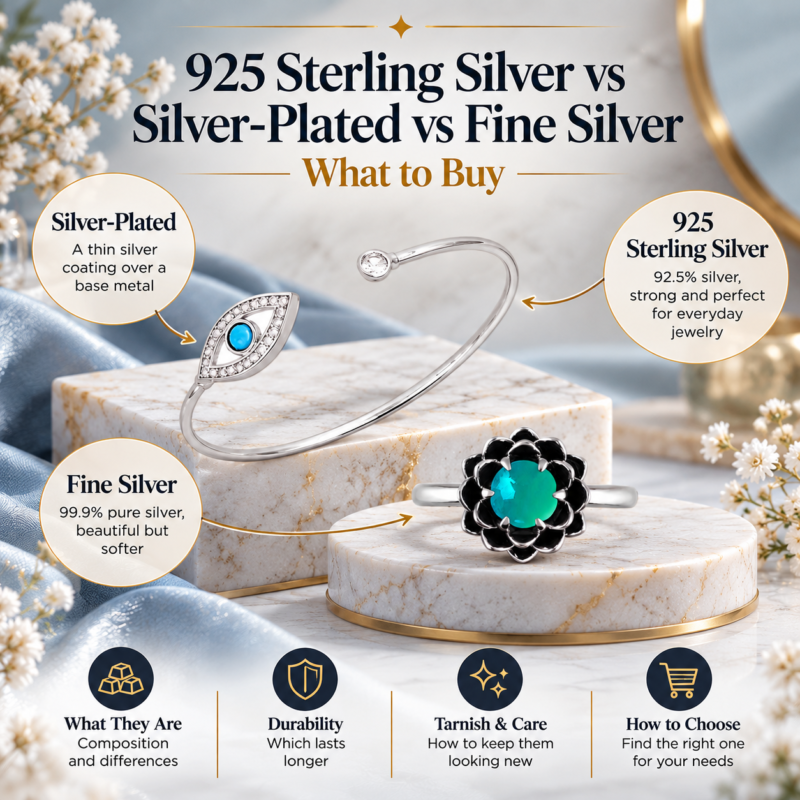
Turquoise and sterling silver are a classic combination for a reason. The cool white of 925 sterling silver (92.5% silver and 7.5% other metals, usually copper) makes blue turquoise look even brighter. Rhodium-plated sterling silver adds a brighter, whiter finish and can slow down tarnishing. Gold-tone settings give turquoise a warmer, more vintage feel. Just remember that gold-plated or vermeil pieces have a thin gold layer over a base metal, so they’re not solid gold.
Style it for real life
- Everyday: small turquoise studs or huggies with jeans and a white tee.
- Office: a single turquoise pendant on a fine 18-inch chain against a navy, camel, or gray top.
- Holiday parties: turquoise drop earrings with a cream sweater or a black dress for a pop of color.
- Layered looks: turquoise pairs well with plain silver chains and other blues, like blue topaz or chalcedony.
How to Care for Turquoise
Turquoise isn’t fragile exactly, but it’s sensitive. A few simple habits make a big difference.
| Do | Don’t |
|---|---|
| Put your turquoise on last, after lotion, perfume, and hairspray | Wear it in the shower, pool, or hot tub |
| Wipe it gently with a soft, dry, or barely damp cloth | Use ultrasonic cleaners or steam cleaners |
| Store it in its own pouch or a lined compartment | Toss it in a drawer with harder gems that can scratch it |
| Polish the silver carefully around the stone with a silver cloth | Dip it in liquid silver cleaner or soak it in any chemical |
| Take it off for workouts, cleaning, and gardening | Leave it in direct sun or high heat for long periods |
Over time, natural untreated turquoise can deepen or shift slightly greener as it absorbs skin oils. Some collectors actually love that aged look. Stabilized turquoise is much less likely to change.
Turquoise as a Holiday or Birthday Gift
For a December birthday, a turquoise piece feels personal without being over the top, and its traditional association with friendship and good luck gives you an easy line to write in the card. For a safe gift, choose earrings or a pendant, since you don’t need to guess a ring size. If you’re shopping for someone who loves color, these turquoise and enamel silver earrings are a cheerful, easy-to-wear option to consider.
Frequently Asked Questions
Is turquoise the December birthstone?
Yes. Turquoise is one of December’s official birthstones, along with blue topaz, tanzanite, and blue zircon. You can choose whichever one fits the person’s style best. All four share a blue color family, so any of them works for a December birthday.
Can you wear turquoise every day?
You can, especially in earrings and pendants, which don’t get knocked around much. Rings and bracelets need a bit more care because turquoise is softer than many gems. Take it off before washing your hands, swimming, or working out, and it should hold up well.
Why did my turquoise change color?
Natural, untreated turquoise is porous, so it can absorb skin oils, lotion, perfume, or cleaning products. That often makes it look darker or greener over time. Stabilized turquoise resists this much better, which is one reason it’s so common in jewelry.
Is stabilized turquoise real turquoise?
Yes. Stabilized turquoise is genuine turquoise that’s been treated with resin to make it harder and more color-stable. It’s different from imitation turquoise, which is a different material, like dyed howlite, made to look like turquoise. A good seller should tell you which type you’re buying.