Blog
How to Spot Fake Sterling Silver: 7 Easy Checks at Home

Black Friday deals, holiday markets, and online marketplaces are full of jewelry labeled “sterling silver” right now. Most of it is honest. Some of it isn’t. If you’ve ever bought a “silver” ring that turned your finger green in a week, you already know how that feels. The good news is you don’t need a lab to protect yourself. A few simple checks at home, plus some smart questions before you hit “buy,” will catch most fakes.
What Real Sterling Silver Actually Is
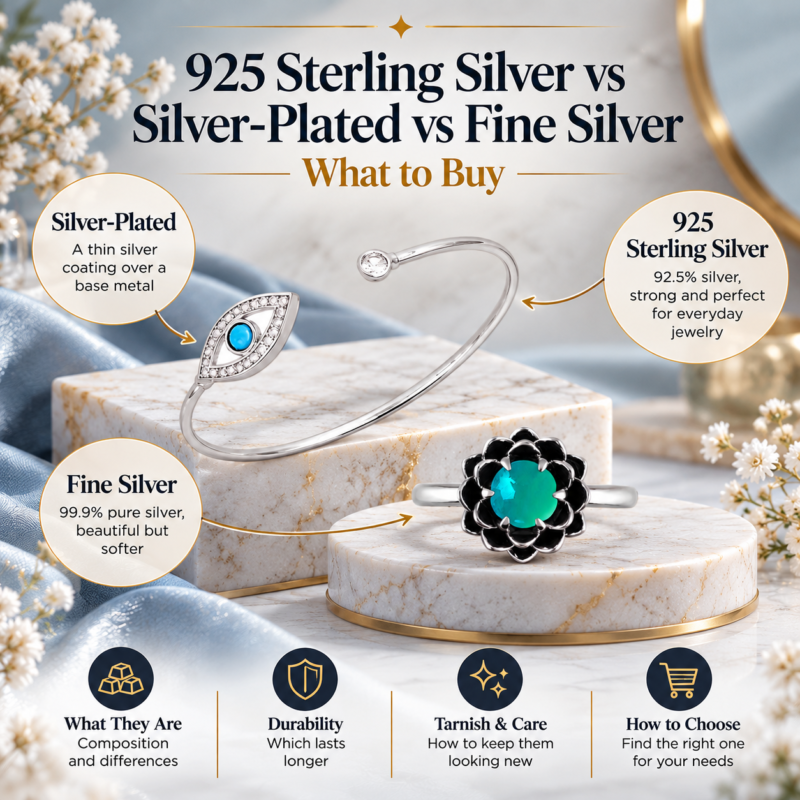
Before you can spot a fake, it helps to know what you’re looking for. Real 925 sterling silver is an alloy of 92.5% silver and 7.5% other metals, usually copper. That small amount of copper makes the metal strong enough for rings, clasps, and prong settings. It’s the same alloy all the way through, so if you scratched deep into a sterling piece, you’d still find sterling.
A “fake” usually falls into one of these groups:
- Silver-plated base metal: brass, copper, or another alloy with a thin silver coating. Not fake if it’s labeled honestly, but it’s not sterling.
- “German silver” or “nickel silver”: a copper, nickel, and zinc alloy that contains no silver at all, despite the name.
- “Tibetan silver” or “silver tone”: vague terms that often mean little or no actual silver.
- Mislabeled pieces: items stamped 925 that simply aren’t.
When you shop our 925 sterling silver jewelry, the metal is listed on every product page, and that’s exactly the kind of clear labeling you should expect from any seller.
7 Ways to Check for Fake Sterling Silver at Home
No single home test is perfect. Think of these like clues: the more a piece passes, the more confident you can be.
1. Look for the stamp
Real sterling is usually marked somewhere discreet: inside a ring band, on a clasp, or on the back of a pendant. Common marks include 925, .925, S925, STER, and Sterling. Grab your phone’s magnifier, because these stamps are tiny.
Here’s the catch: stamps can be faked too. A sloppy, uneven, or blurry stamp on an otherwise cheap-feeling piece is a red flag. And some genuine pieces, like very delicate chains or older handmade jewelry, may have no stamp at all. Use the stamp as a starting point, not the final word.
2. Try the magnet test
Silver isn’t magnetic. Hold a strong magnet (a fridge magnet is often too weak; a neodymium magnet from a hardware store works better) right up to the piece. If it snaps on firmly, the main body of the piece almost certainly isn’t sterling.
Keep in mind that clasps and springs sometimes contain a little steel, so a slight tug on the clasp alone isn’t a deal breaker. Also, plenty of non-magnetic metals aren’t silver, so passing this test doesn’t prove much on its own. Failing it, though, tells you a lot.
3. Do the ice test
Silver conducts heat extremely well. Set an ice cube on a flat part of the piece (or on a silver coin or bar if you’re testing one) next to another ice cube on a plate. On real silver, the ice starts melting noticeably faster, almost like it’s sitting on something warm. This works best on chunkier pieces like cuffs and wide bands. On a thin chain, it’s hard to read.
4. Rub it with a white cloth
Gently rub a hidden spot with a soft white cloth or an unused silver polishing cloth. Silver oxidizes when it meets air, so a dark gray or black smudge on the cloth is a decent sign you’re dealing with real silver. A clean cloth doesn’t automatically mean fake, though. Rhodium-plated sterling, which is very common, is designed to resist tarnish and may leave no mark.
5. Check the edges and high-wear spots
Plating wears off first where jewelry rubs: the underside of a ring, the edges of a pendant, clasps, and the ends of hoops. If you see a yellowish, pinkish, or coppery color peeking through, the piece is likely plated base metal. Real sterling can scratch and tarnish, but it won’t reveal a different-colored metal underneath.
6. Notice how it smells and feels
This one’s subtle, but it helps. Sterling silver has little to no smell. Brass and copper-heavy alloys often leave a sharp metallic odor on your fingers after handling. A green or black mark on your skin after a few hours isn’t proof either way (even real sterling can react with sweat and lotion), but a piece that turns your finger green in a day or two deserves a second look.
7. Do a reality check on price
Silver is a precious metal with a real market price. If a chunky “solid sterling” cuff costs less than a fancy coffee, ask yourself how that’s possible. Very low prices aren’t proof of a fake, but they’re a reason to look closer at the stamp, the seller, and the product details.
Quick Comparison: Home Tests at a Glance
| Test | What real sterling does | Red flag | How much to trust it |
|---|---|---|---|
| Stamp check | Clear 925, .925, STER, or Sterling mark | Blurry, crooked, or missing stamp on a cheap piece | Helpful, but stamps can be faked |
| Magnet test | No attraction | Magnet sticks firmly to the main body | Good at catching fakes, can’t confirm real |
| Ice test | Ice melts quickly | Ice melts at the same pace as on a plate | Best for larger, flat pieces |
| White cloth rub | Gray or black residue | None, on a piece that isn’t rhodium plated | Moderate |
| Edge inspection | Same color throughout | Yellow or copper tones showing through | Very useful for spotting plating |
| Price check | Priced in line with similar sterling pieces | Far below what other sellers charge | A warning sign, not proof |
Tests You Should Skip
You’ll find a few “hacks” online that do more harm than good:
- The bleach test: bleach does make silver tarnish fast, but it can also damage the finish and harm gemstones, pearls, and glue-set stones.
- Scratching deep into the metal: it ruins the piece and doesn’t tell you much without testing supplies.
- Home acid kits on gemstone jewelry: acid can etch soft stones like opal, turquoise, and pearl. If you want an acid test, let a jeweler do it.
For an expensive or sentimental piece, a local jeweler can test it properly. Many use acid testing on a hidden spot or an XRF (X-ray fluorescence) scanner, which reads the metal content without damaging anything.
How to Buy Real Sterling Silver Online
The easiest way to avoid fakes is to buy from sellers who are upfront about materials. Before you check out, look for these things:
- A specific metal description: “925 sterling silver” is clear. “Silver tone,” “silver color,” or “fashion silver” usually means it isn’t sterling.
- Details on any plating: rhodium plating or gold over sterling should be named, and gold-plated pieces should never be described as solid gold.
- Clear stone information: an honest listing tells you whether a stone is natural, lab-created, or simulated (like cubic zirconia).
- A real return policy: legitimate sellers stand behind what they sell.
- Customer service you can actually reach: ask what the alloy is. A good seller can answer.
If you’re shopping for someone on your holiday list, a ring is a classic choice, and you can browse our women’s ring collection knowing the metal and stones are spelled out before you buy.
Frequently Asked Questions
Does a 925 stamp guarantee my jewelry is real sterling silver?
Not completely. A 925 stamp is a good sign, but counterfeit pieces can carry fake stamps too. Combine the stamp with other checks, like the magnet test and a look at the edges, or have a jeweler test it if you’re unsure.
Will real sterling silver turn my finger green?
It can, occasionally. The copper in sterling may react with sweat, lotion, or soap and leave a faint green or dark mark, which washes off. Heavy, fast discoloration is more typical of copper or brass pieces with thin plating.
Is sterling silver supposed to tarnish?
Yes. Tarnish is a normal surface reaction between silver and sulfur in the air, and it’s actually a mild sign that a piece contains real silver. It polishes off easily with a silver cloth, and rhodium-plated sterling tarnishes much more slowly.
What is the difference between German silver and sterling silver?
German silver, also called nickel silver, is an alloy of copper, nickel, and zinc with no actual silver in it. Sterling silver is 92.5% silver. If you have sensitive skin, it’s worth knowing that nickel silver contains nickel, so always check what a piece is made of.
Can a jeweler test silver without damaging it?
Often, yes. Many jewelers use an XRF scanner, which reads metal content without touching the surface. Acid testing is also common, but it’s done on a tiny hidden spot, so ask which method they use before they start.