Blog
Earrings for Your Face Shape: A Simple Styling Guide

Ever bought a pair of earrings that looked amazing on the model and just… off on you? It usually isn’t the earrings. It’s the shape. Earrings sit right next to your jawline and cheekbones, so their outline either echoes your face shape or balances it. Once you know which one you want, picking from a wall of women’s earring styles gets a lot easier.
This guide walks you through finding your face shape in about two minutes, which earring shapes tend to flatter each one, and the small mistakes that throw the whole look off.
First, Figure Out Your Face Shape
Pull your hair back, stand in front of a mirror, and look at three things: how long your face is compared to how wide it is, where it’s widest (forehead, cheekbones, or jaw), and whether your jawline is soft and rounded or angular.
If you want to be more precise, grab a soft tape measure and note these four numbers in inches:
- Forehead: across the widest part, roughly halfway between eyebrows and hairline.
- Cheekbones: across the highest point of each cheekbone, just below the outer corner of your eyes.
- Jawline: from the tip of your chin to just below your ear, then double it.
- Face length: from the center of your hairline down to the tip of your chin.
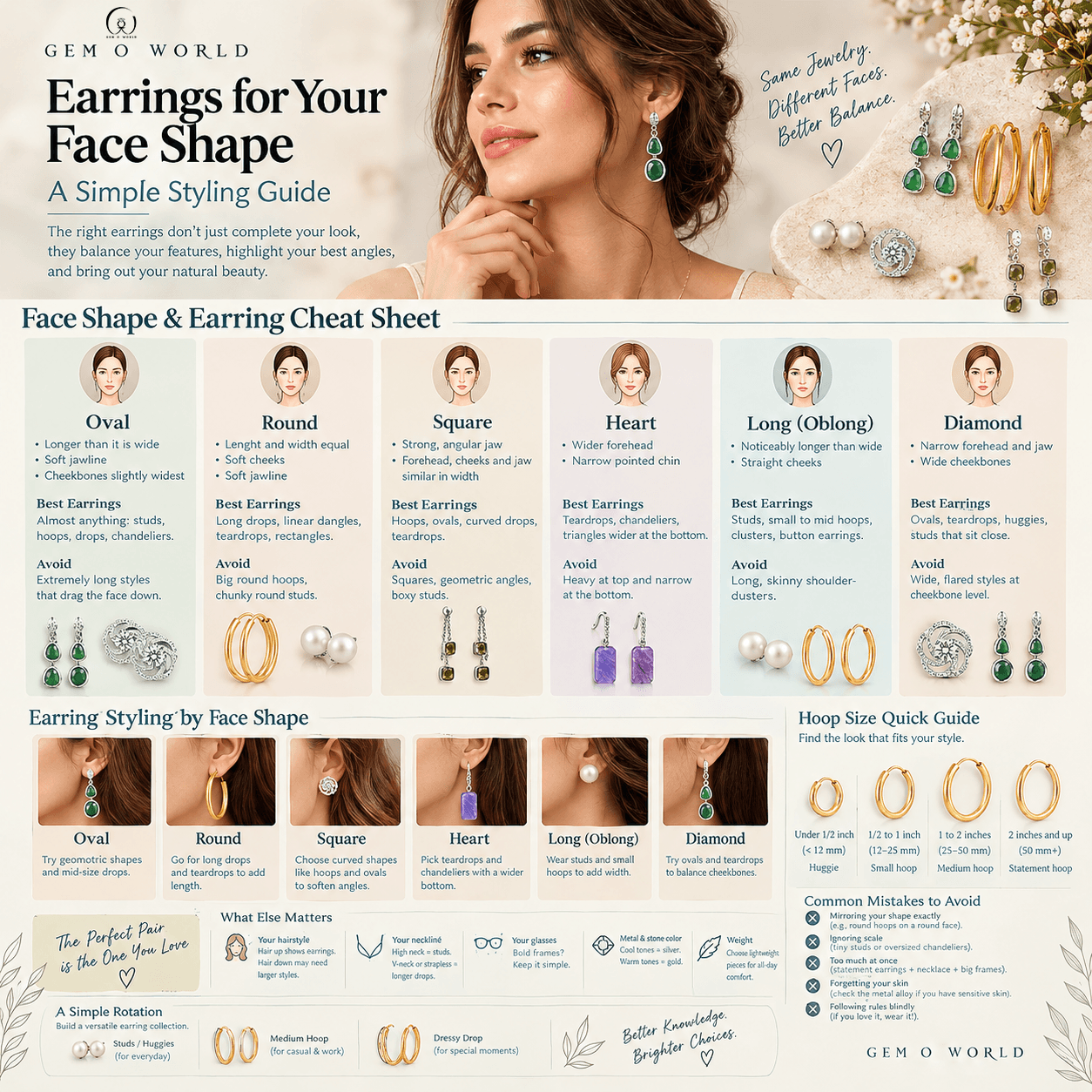
Compare them with the chart below. Most people are a mix of two shapes, so go with whichever description sounds the most like you.
Face Shape and Earring Cheat Sheet
| Face shape | How to spot it | Earrings that tend to flatter | Go easy on |
|---|---|---|---|
| Oval | Longer than it is wide, softly rounded jaw, cheekbones slightly widest | Almost anything: studs, hoops, drops, chandeliers | Extremely long styles that drag the face down |
| Round | Length and width about equal, full cheeks, soft jaw | Long drops, linear dangles, teardrops, rectangles | Big round hoops, chunky round studs |
| Square | Strong, angular jaw; forehead, cheeks, and jaw similar in width | Hoops, ovals, curved drops, teardrops | Squares, geometric angles, boxy studs |
| Heart | Wider forehead, narrow pointed chin | Teardrops, chandeliers, triangles wider at the bottom | Styles that are heavy at the top and narrow at the bottom |
| Long (oblong) | Noticeably longer than wide, straight cheeks | Studs, small to mid hoops, clusters, button earrings | Long, skinny shoulder-dusters |
| Diamond | Narrow forehead and jaw, wide cheekbones | Ovals, teardrops, huggies, studs that sit close | Wide, flared styles at cheekbone level |
What to Wear for Each Face Shape
Oval: You’ve Got Options
Oval faces are balanced, so you can follow your mood more than any rule. A good test is scale: if your features are delicate, mid-size drops around 1 to 1.5 inches long tend to look intentional rather than overwhelming. Try a geometric shape here, since you don’t need to soften or sharpen anything.
Round: Add Length
The goal is to draw the eye down and create a little vertical line. Linear drops, slim bar earrings, and teardrops that hang below the earlobe all do this nicely. If you love hoops, look at oval or elongated hoops rather than perfectly round ones, which can repeat the curve of your cheeks.
Square: Soften the Angles
A strong jaw looks great with curves near it. Classic round hoops, oval drops, and anything with a rounded silhouette create a nice contrast. Hoops in the 1 to 2 inch (about 25 to 50 mm) range are a sweet spot for most square faces. Skip sharp squares and rectangles that sit right at jaw level.
Heart: Add Width at the Bottom
Since your face is widest at the forehead, earrings that flare out near the chin help balance things. Teardrops, chandelier styles, and triangle shapes with the wide end down are all smart picks. A gemstone drop with the stone at the bottom, like a pear-shaped sapphire or emerald, works especially well.
Long: Keep It Close and Wide
You want to add width, not length. Studs, cluster earrings, small hoops, and huggies sit near the ear and visually widen the face. If you want a drop, keep it short, around an inch, with a rounder shape at the end.
Diamond: Balance the Cheekbones
Your cheekbones are the star. Earrings that are narrower at the top and fuller at the bottom, such as ovals and teardrops, soften the angles. Huggies and simple studs are easy everyday choices that don’t compete with your bone structure.
Hoop Size Quick Guide
Hoops are the most common earring people ask about, so here’s a rough sense of how each size reads when worn. Hoop sizes are usually listed by diameter.
| Diameter | Approx. mm | How it looks |
|---|---|---|
| Under 1/2 inch | Under 12 mm | Huggie, hugs the earlobe; great for second holes |
| 1/2 to 1 inch | 12 to 25 mm | Small everyday hoop, office-friendly |
| 1 to 2 inches | 25 to 50 mm | Classic medium hoop, noticeable but versatile |
| 2 inches and up | 50 mm+ | Statement hoop, often near the jawline |
Things That Matter More Than Face Shape
Face shape is a helpful starting point, not a law. A few other things change how earrings look on you just as much:
- Your hairstyle. Hair down covers most of a stud, so you may want a drop. A sleek bun or short cut shows off everything, even small huggies.
- Your neckline. Turtlenecks and high collars pair well with studs or short drops. Strapless and V-necks give long earrings room to swing.
- Your glasses. Bold frames already add a shape near your face. Simple studs or slim hoops keep things from getting busy.
- Metal and stone color. Cool-toned stones like blue topaz, amethyst, and moonstone often look crisp in 925 sterling silver (92.5% silver, usually alloyed with copper). Warm stones like citrine and garnet can glow in gold-plated or gold-filled settings.
- Weight. A heavy earring that pulls your lobe down never looks right, whatever the shape. Look for lighter designs if you plan to wear them all day.
Common Mistakes to Avoid
- Mirroring your shape exactly. Round hoops on a very round face, or sharp squares on a very square jaw, tend to exaggerate rather than flatter.
- Ignoring scale. Petite features can get lost behind giant chandeliers, and tiny studs can disappear on a bigger frame.
- Too much near the face at once. Statement earrings plus a statement necklace plus big frames is a lot. Pick one star.
- Forgetting your skin. If your ears are sensitive, sterling silver is often a good option, but check what the post and alloy are made of and stop wearing anything that irritates.
- Treating rules as rules. If you love a pair that “breaks” the guidelines and you feel great in it, wear it. Confidence beats geometry.
Putting It All Together
Start with the cheat sheet, try one or two shapes that balance your face, and then adjust for your hair, neckline, and everyday routine. Most people end up with a small rotation: a pair of studs or huggies for daily wear, a medium hoop, and one dressier drop. If you’re ready to add that dressier pair, browse our sterling silver dangle earrings and see which silhouettes feel like you.
Frequently Asked Questions
How do I know my face shape for earrings?
Pull your hair back and compare the width of your forehead, cheekbones, and jaw, plus how long your face is overall. If length and width are close, you’re likely round or square; if it’s clearly longer, you’re oval or long. The widest point and how angular your jaw is will narrow it down from there.
Do hoop earrings look good on a round face?
They can. Oval or elongated hoops, or hoops with a small drop hanging from them, add length and work well on round faces. Very large, perfectly circular hoops are the ones that can echo the roundness of your cheeks.
What earrings are best for a long or narrow face?
Pick styles that add width rather than length, like studs, clusters, huggies, and small to medium hoops. If you want a drop, keep it short and choose a rounder shape at the bottom.
Can I wear long earrings with short hair?
Absolutely, and short hair actually shows them off. Just keep scale in mind: with a pixie or short bob, slim linear drops often look more polished than wide, heavy chandeliers.