
Blog
How a Piece of Jewelry Is Created: Every Step from Design to Finished Jewelry

Have you ever wondered how a piece of jewelry is created? Every beautiful ring, necklace, bracelet, or pair of earrings begins as a simple idea before skilled designers and craftsmen transform it into a finished masterpiece. Understanding how a piece of jewelry is created helps you appreciate the creativity, precision, and craftsmanship behind every design.
Every piece of jewelry starts as an idea. Before it reaches a jewelry box, it passes through many skilled hands. Designers, craftsmen, stone setters, and polishers join forces. They transform a simple idea into a finished piece.
Today, jewelry making combines traditional craftsmanship with modern technology. Every step matters. Every step matters. From the first sketch to the final touch, we create jewelry. It’s beautiful, strong, and built to last.
Let's explore the complete jewelry manufacturing process.
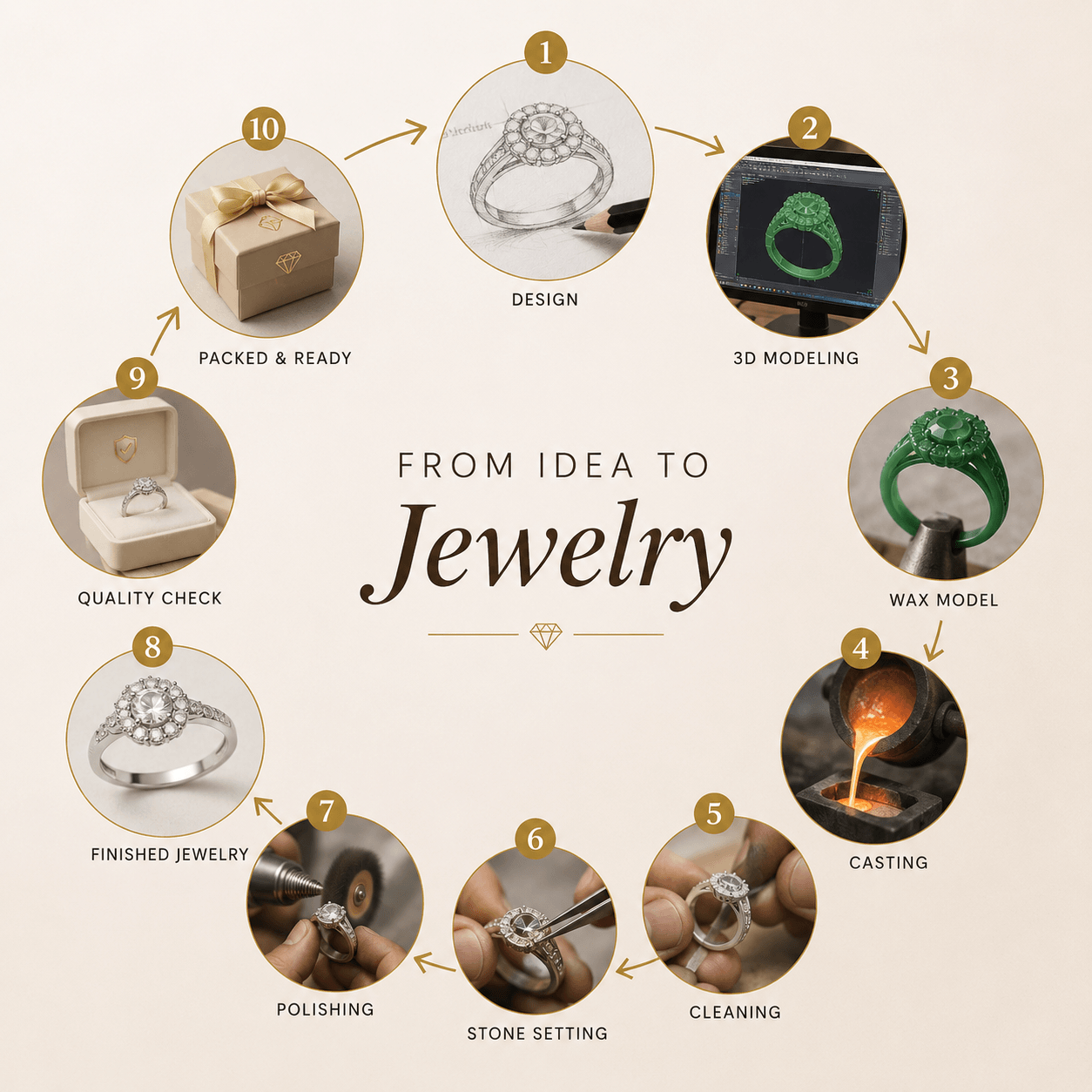
How a Piece of Jewelry Is Created Step by Step
Here is a step-by-step guide:
1. Designing the Jewelry
Every jewelry piece begins with an idea.
Designers find inspiration from nature, art, fashion, architecture, or customer requests. They sketch different ideas before choosing the final design.
During this stage, they decide:
- The type of jewelry
- The metal to use
- The gemstones
- The size and shape
- The overall style
Once the design is approved, it is ready for the next step.
2. Creating a 3D CAD Model
Most jewelry manufacturers now use Computer-Aided Design (CAD) software.
The hand sketch is turned into a detailed 3D digital model. Designers can rotate the model and view it from every angle.
This helps them:
- Check measurements
- Adjust stone placement
- Improve comfort
- Reduce mistakes
- Estimate metal weight
It’s easier to make changes on a computer. Changing jewelry after production starts is harder.
3. Making the Wax Model
The digital design is used to create a wax model.
Many manufacturers use high-quality 3D wax printers. Some skilled craftsmen still carve wax models by hand for custom designs.
The wax model looks exactly like the finished jewelry. It will be used to make the casting mold.
4. Casting the Metal How a piece of jewelry is created
This is where the jewelry starts to take shape.
The wax model is attached to other wax models on a wax tree. The tree is placed inside a metal flask.
Liquid plaster is poured around the wax and allowed to harden.
The flask is then heated in a special furnace. The wax melts and flows out, leaving an empty mold behind. This process is called lost wax casting.
Molten gold, sterling silver, or platinum is poured into the mold.
After the metal cools, the plaster is broken away. The rough jewelry pieces are now visible.
5. Cleaning the Cast Piece
The jewelry is removed from the casting tree.
Extra metal is cut away, and rough areas are cleaned.
At this stage, craftsmen:
- Remove casting marks
- Smooth rough edges
- Clean the surface
- Prepare the jewelry for finishing
The piece now begins to look like real jewelry.
6. Filing and Assembly-How a Piece of Jewelry Is Created
Many jewelry designs have several parts.These parts are joined together using soldering.
Craftsmen also:
- File rough edges
- Shape the metal
- Smooth corners
- Check the size
- Improve every small detail
This stage requires patience and precision.
7. Setting the Gemstones
Stone setting is one of the most skilled jobs in jewelry making.
Each gemstone is placed by hand.
Different styles are used depending on the design.
Prong Setting
Small metal claws hold the stone while allowing plenty of light to enter.
Bezel Setting
A metal rim surrounds the gemstone for extra protection.
Pavé Setting
Many small stones are placed close together to create a sparkling surface.
Channel Setting-How a Piece of Jewelry Is Created
The stones sit between two metal walls without visible prongs.
Flush Setting
The gemstone sits level with the metal for a smooth finish.
After every stone is set, it is checked carefully to make sure it is secure.
8. Polishing the Jewelry
The jewelry is polished several times.
This removes scratches and gives the metal a smooth, bright finish.
Different finishes can be created, including:
- High polish
- Matte finish
- Satin finish
- Brushed finish
- Hammered texture
- Antique oxidized finish
The right finish depends on the design and style of the jewelry.
9. Plating the Jewelry
Some jewelry receives an extra layer of metal.
Sterling silver jewelry is often coated with rhodium. This makes it brighter and helps protect it from tarnishing.
Silver jewelry may also receive yellow gold or rose gold plating for a different look.
Before plating, every piece is cleaned carefully to make sure the coating is even.
10. Quality Inspection
Before the jewelry is sold, it goes through a detailed inspection.
Experts check:
- Stone security
- Surface finish
- Metal quality
- Size and weight
- Clasps and chains
- Overall appearance
Only jewelry that meets high standards moves to the next stage.
11. Final Cleaning
Even after polishing, tiny amounts of dust and polishing compound can remain.
The jewelry is cleaned using ultrasonic machines and steam cleaners.
This removes dirt and brings out the natural shine of the metal and gemstones.
12.Hallmarking and Certification
Many jewelry pieces receive official hallmarks.
These marks show the purity of the metal.
Common examples include:
- 925 for sterling silver
- 14K gold
- 18K gold
- Platinum purity marks
Gemstone jewelry may also come with a certificate of authenticity.
These details give customers confidence in their purchase.
13. Product Photography
Before the jewelry is listed for sale, it is photographed.
Professional images show every detail of the design.
Manufacturers usually take:
- White background photos
- Lifestyle images
- Close-up shots
- Model photos
- Detail images
Good photography helps customers shop with confidence.
14. Packaging
The finished jewelry is packed with care.
It is placed inside:
- A jewelry box
- A soft pouch
- Protective wrapping
- Anti-tarnish packaging for silver
- Care instructions
- Branded gift packaging
Good packaging protects the jewelry and creates a memorable unboxing experience.
15. Shipping to Customers-How a Piece of Jewelry Is Created
The final step is delivery.Each order is checked one last time before shipping.
Once it reaches the customer, the jewelry becomes part of someone's story. It may celebrate a birthday, an anniversary, a wedding, or another special moment.
Why Every Step Matters
Making jewelry is a team effort. Designers, CAD experts, casters, polishers, stone setters, and quality inspectors all play key roles. Each one is important.
Modern machines boost speed and accuracy. Still, skilled hands make every design come alive. Their experience helps create jewelry that is beautiful, comfortable, and made to last.
Skilled Hands Behind Every Piece
A beautiful piece of jewelry is never made by one person alone. It is the result of teamwork. Designers create the concept. CAD experts build the digital model. Wax technicians prepare the mold. Casters shape the metal. Stone setters place each gemstone with care. Polishers add shine. Quality inspectors check each detail before packing the piece.
Each expert has years of training and experience. Even with modern machines, many steps still require careful handwork. A steady hand and a sharp eye make all the difference. This is why handcrafted details remain one of the most valuable parts of fine jewelry.
The Value of Quality Manufacturing
Good jewelry is not only about beauty. It should also be strong enough for everyday wear. A good piece keeps its shape, holds gems securely, and stays comfy over time.
High-quality manufacturing also reduces waste and improves consistency. Every stage, from selecting raw materials to the final inspection, follows strict standards. This makes sure every customer gets jewelry that looks great and lasts for years.
When you learn the story behind each ring, necklace, bracelet, or pair of earrings, you see more than just a piece. Each item has its own tale. You can see the skill and care in turning raw materials into something special. It becomes meaningful and lasting.
Final Thoughts
A piece of jewelry is much more than metal and gemstones. It is the result of creativity, planning, skill, and careful attention to detail.
From the first sketch to the final polish, every stage adds value to the finished piece. Next time you wear a ring, pendant, bracelet, or earrings, think about the skilled hands that made them. Every shine, every setting, and every detail is the result of a remarkable journey.